

Reduce HAI Penalties.
Protect Your Medicare Revenue.
Exit the HACRP Penalty Zone.
IP&MA partners with acute-care hospitals to improve infection prevention programs, reduce healthcare-associated infections, and recover CMS Hospital-Acquired Condition Reduction Program (HACRP) penalty dollars through structured, evidence-based engagement.
All HACRP program fees are fully inclusive
-
4.7x
Average Year-1 ROI on program fee
-
30-40%
Typical CDI reduction within 12 months
-
20-30%
SSI rate reduction with bundle implementation
-
3
Simultaneous assessment workstreams, Starting Day 1
The Financial Case
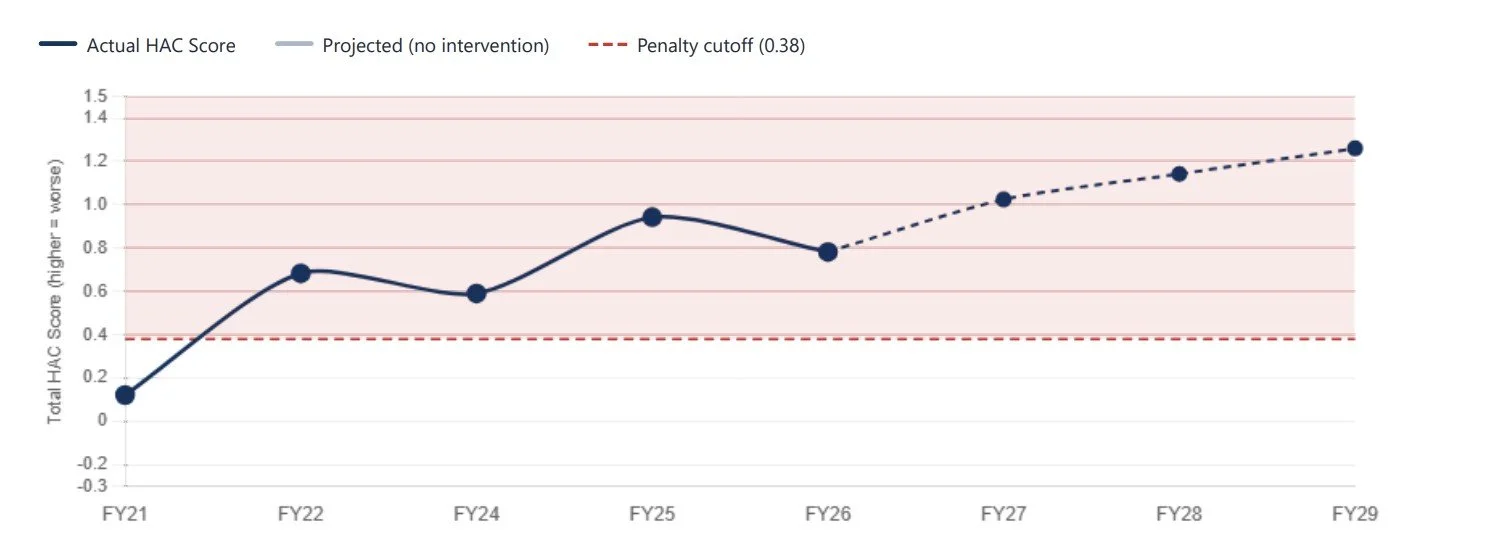
The annual CMS HACRP penalty for a community hospital in the penalty zone commonly ranges from $355,000 to over $1.3M — before accounting for HRRP readmission penalties, value-based purchasing shortfalls, or the direct clinical cost of HAI events.
In most engagements, penalty recovery in Year 1 exceeds the all-inclusive program fee on the HACRP line alone.
The combined CMS exposure facing a typical penalized hospital ranges from $1.5M to $5.8M per year. IP&MA's engagement is scoped to address the infection-prevention-modifiable share of that exposure. A hospital-specific ROI analysis is included in every proposal.
ROI estimates are based on conservative assumptions and each hospital's actual CMS penalty data. HACRP penalty recovery is the most predictable component — it is automatic once penalty zone exit is achieved, and achieving it is a shared responsibility between IPMA and the facility. HRRP and clinical cost figures are directional estimates refined after the Phase 1 assessment. Actual outcomes depend on implementation fidelity, patient population, and operational variables outside IP&MA's control.
Program fee:
All-inclusive, varies by hospital & travel requirement
HACRP penalty recovery upon exit
$355K - $1.3M+ (typical range)
HRRP improvement
Conservative 30% reduction (hospital specific)
HAI clinical cost reduction
Conservative 40% (hospital specific)
Probable Net Year-1 Return detailed in your proposal
What We Address
IP&MA's work spans all six HACRP-reported HAI measures plus the upstream data, surveillance, and program infrastructure that determines your CMS scores.
-
NHSN Data Integrity & Surveillance Audit
Many hospitals carry inflated scores due to miscoded events or denominator errors — not true clinical failures. IP&MA's data integrity audit corrects coding inconsistencies, verifies denominator methodology, and eliminates artificial score inflation before intervention begins. At community hospital scale, a single miscoded event can shift a W-Z score by 0.2+ points.
-
C. difficile (CDI) Reduction
CDI is typically the highest W-Z score contributor at community hospitals. IPMA implements a full CDI Prevention Bundle — antibiotic stewardship integration, testing stewardship per IDSA/SHEA guidelines, sporicidal environmental decontamination, and contact-plus precautions. Targeted fluoroquinolone and broad-spectrum cephalosporin restriction has demonstrated 20-40% CDI reduction in comparable hospital studies.
-
MRSA Bacteremia Prevention
IP&MA implements active MRSA surveillance protocols for ICU admissions and ICU decolonization programs using the REDUCE MRSA trial methodology (chlorhexidine bathing + intranasal mupirocin). Contact precautions compliance monitoring and physician engagement are integrated throughout the intervention phase.
-
Surgical Site Infection (SSI) Prevention
IP&MA deploys a CNOR-certified surgical services specialist alongside our IP consultants for SSI-driven engagements. On-site OR practice observation, pre/post-operative bundle audit, antibiotic timing review, and confidential surgeon-specific feedback are the core components — calibrated to your specific procedure mix and NHSN outlier profile.
-
CAUTI & CLABSI Prevention
Catheter-associated infections are among the most protocolresponsive HAI types. IP&MA reviews insertion technique, daily necessity assessment workflows, nursing-driven removal protocols, and catheter utilization ratios. For CLABSI, we audit bundle compliance and central line insertion practices — with particular attention to device-day denominator accuracy and divergences between raw event counts and W-Z scores.
-
HACRP Score Monitoring & CMS Trajectory Modeling
IP&MA conducts monthly NHSN surveillance reviews, giving hospital leadership a consistent view of HAI event trends and measure-level trajectory throughout the year. We track the full HACRP measurement window and flag threshold risks before they become confirmed penalty exposure — so corrective action can begin while there is still time in the measurement period.
Phase 1: Rapid IP Program Assessment
Months 1-2
Standalone service or full program entry point
A compressed, high-density assessment of your infection prevention program — NHSN data, clinical practices, and HAI drivers — before any intervention begins.
Three-day on-site assessment with simultaneous workstreams — team composition calibrated to penalty profile (CNOR deployed in OR when SSI is a HACRP penalty driver; IP Consultant on NHSN audit; IP Consultant on unit rounding)
NHSN data integrity audit — event definitions, denominator methodology, case confirmation records, and reporting completeness for all six HACRP measures
CDI root cause analysis — facility-onset vs. community-onset classification, antibiotic stewardship gap analysis, environmental decontamination review
SSI surveillance methodology review — operative case identification, post-discharge surveillance, pre-op bundle compliance
IP staffing model and policy assessment against current APIC, SHEA, and IDSA guidelines
Deliverable: Written Findings & Recommendations Report Prioritized gap list with HACRP score impact estimates per gap, quick-win identification (actions within 30 days), and a full 12-month performance roadmap with measure-level targets.
Phase 2: Intervention
Months 3-9
Evidence based HAI reduction programs
Structured intervention programs targeting your hospital's highest-impact HACRP measures, sequenced by W-Z score contribution and time-to-impact.
CDI Prevention Bundle — hand hygiene, contact-plus precautions, testing stewardship, sporicidal decontamination, antibiotic stewardship integration (targeted restriction shown to reduce CDI 20–40%)
SSI Prevention Program — pre-op bundle (CHG bathing, MRSA decolonization, glycemic control), intraoperative antibiotic timing, post-discharge surveillance, confidential surgeon-specific feedback
CAUTI Prevention — insertion technique, daily necessity assessment, nursing-driven removal protocols, catheter utilization ratio tracking
MRSA Prevention — active surveillance, ICU decolonization protocol (REDUCE MRSA methodology), contact precautions compliance monitoring
CLABSI Prevention — bundle compliance audit, central line insertion practice review, device-day denominator accuracy
Sepsis SEP-1 Infection-Driven Elements — blood culture practices, antibiotic timing review, early sepsis recognition nursing education
Deliverable: Ongoing monthly reporting structure and plan, protocol implementation documentation, monthly NHSN surveillance reviews, HAI event tracking, and corrective action follow-up. Three onsite visits.
Phase 3: Monitoring and Optimization
Months 10-12 + Annual Renewal Option
Ongoing program support
Phase 3 concludes with a final oversight visit to monitor and support progress, with plans for sustained internal oversight through the CMS measurement window — ensuring improvements hold, projecting your penalty zone exit trajectory, and transitioning ongoing monitoring to your internal team.
Penalty exit confirmation — formal written communication to leadership when IPMA projects with confidence that the hospital will exit the penalty zone
Ongoing program support option includes:
Quarterly NHSN surveillance reviews shared with IP Director, CNO, and CMO
Quarterly on-site IP rounding and protocol compliance audit
HACRP measurement window tracking — IPMA flags any measure approaching a threshold that could threaten the penalty exit target
Annual HACRP readiness scorecard — prepared each September before CMS finalizes the next fiscal year's scores
CDI program protection — antibiotic stewardship integrity review; early warning if formulary or environmental changes threaten CDI gains
Deliverables: Annual HACRP Readiness Scorecard Measure-level W-Z projections, penalty zone exit trajectory, and sustainability assessment for all implemented protocols.